Force partitions on a schedule, then watch leader churn, stalled writes, and log repair under continuous stress.
2026-06-24
Introduction
If you're digging into distributed systems, consensus is one of the first big topics you run into, and Raft is usually where people start. A couple weeks ago I sat down to actually learn how it works, and the first thing I did was read the Raft paper, a pretty approachable 18 pages.
I also like breaking things on purpose, so that's what this piece is: a five-node Raft cluster, three fault scenarios I threw at it, and the ugly parts that only show up once you actually stress the thing instead of just reading the paper.
Correct under ideal conditions is not the same as correct.
What we're watching for
Three scripted failure scenarios, each targeting a different way this can go wrong. No touching anything mid-run, I let each one play out end to end, then log the results so I can rerun it and get the same answer.
[1] Leader churn
Flap a partial partition and see if elections ever settle
N1 is leader, connected to N2 and N3, cut off from N4 and N5.
N4/N5 lose heartbeats, time out, and start an election they can't win, 2 votes out of 5.
They keep trying, term climbing, while N1 keeps replicating to N2/N3 in the old term.
Heal the link. N4's higher term forces N1 to step down even though N1 had quorum, so a fresh election kicks off for no real reason.
Flap the link again and it repeats.
[2] Stalled writes
Give a leader a write it can't commit, then kill it
N1 is leader but can only reach N2. N3, N4, N5 are unreachable.
A client writes x=5. N1 logs it locally and gets one ack from N2, 2 out of 5, short of a majority.
The write sits uncommitted while the client waits.
N1 crashes before anything heals. N3 gets elected on the majority side with a log that never saw the write.
When N1 comes back, its uncommitted entry gets overwritten.
[3] Log divergence
Isolate a leader completely, let the cluster move on without it, then reconnect
N1 gets cut off from everyone, not just some followers.
A correct implementation should refuse new writes once it can't reach a quorum. If it doesn't, it keeps appending entries locally that can never be committed.
Meanwhile the rest of the cluster elects N3 as leader in a new term and commits different entries at the same log positions.
When the partition heals, N3's AppendEntries forces N1 to throw away its divergent tail and copy N3's instead, the log-matching backtrack doing its job.
Building a Raft
Get a stable five-node cluster running, five being the smallest size that can tolerate a failure and still hold quorum. Each node runs as its own process, all equal participants in consensus.
Node responsibilities
Raft state
currentTerm to track logical time
log[] to store replicated commands
commitIndex and lastApplied for state-machine progress
RPC endpoints
RequestVote for leader election
AppendEntries for log replication and heartbeats
State machine, a minimal key-value store that applies each entry once it's committed. Later experiments check applied state, not just the log, since a committed entry sitting unapplied would otherwise look like a healthy cluster.
Timing configuration
Election timeout and heartbeat interval are tunable, not hardcoded, since they're the levers that decide whether leader churn actually happens once faults show up in phase two.
Five nodes, Docker Compose, one container each on a shared private network. Any instability here just gets amplified once failures are introduced, so it has to be solid first.
The network layer
Take control of every message between nodes so failures can be injected deliberately. Real networks delay, drop, and block messages, so to simulate that we decouple Raft logic from direct communication, every message routes through one intermediary.
Node A→Network Layer→Node B
one control point, where we drop (packet loss), delay (latency), or block (partitions).
Implementation
An application-level transport interface inside the Go code routes every RPC through it, instead of raw HTTP or gRPC calls:
type Transport interface {
    Send(to string, msg Message) error
}
The controller isn't embedded per-node, it's a single centralized service in its own container that every node's Transport implementation calls into. Five independent copies of the partition matrix could disagree with each other, one node seeing a link as blocked while another still sees it open. One shared controller means one view of the network's state, so a partition is a partition everywhere at once, not a race between five inconsistent opinions:
type Network struct {
    mu        sync.RWMutex
    blocked   map[string]map[string]bool
    latency   time.Duration
    dropRate  float64
}
Before sending: check if the link is blocked, apply the random drop probability, apply the artificial delay, then forward if allowed. Every drop, delay, and block gets logged with a timestamp, the from/to pair, and the action, so later phases can line up injected faults against observed Raft behavior instead of guessing at cause and effect after the fact.
Client harness
Give the cluster something that behaves like a real client: it submits writes, deals with leadership changes, and keeps an honest record of what it believes actually succeeded. This is what turns silent data loss from theoretical into detectable.
Client responsibilities
Leader tracking, submits writes to whichever node it currently believes is leader, and follows the redirect when a follower points it elsewhere
Outcome recording, every submission ends in one of three states: submitted, committed, or timeout
Client ledger, a record of every write the client believes was acknowledged, kept independently of the cluster's own log
type LedgerEntry struct {
    Key       string
    Value     string
    Outcome   string
    Timestamp time.Time
}
The ledger earns its keep at analysis time, by cross-checking it against the cluster's committed log after a run. A write the client logged as committed that never shows up in the applied state machine is exactly the silent data loss this whole simulation exists to catch.
Results
[1] Leader churn
Does flapping a partial partition cause runaway elections, and how bad does it get?
1. Term number over time
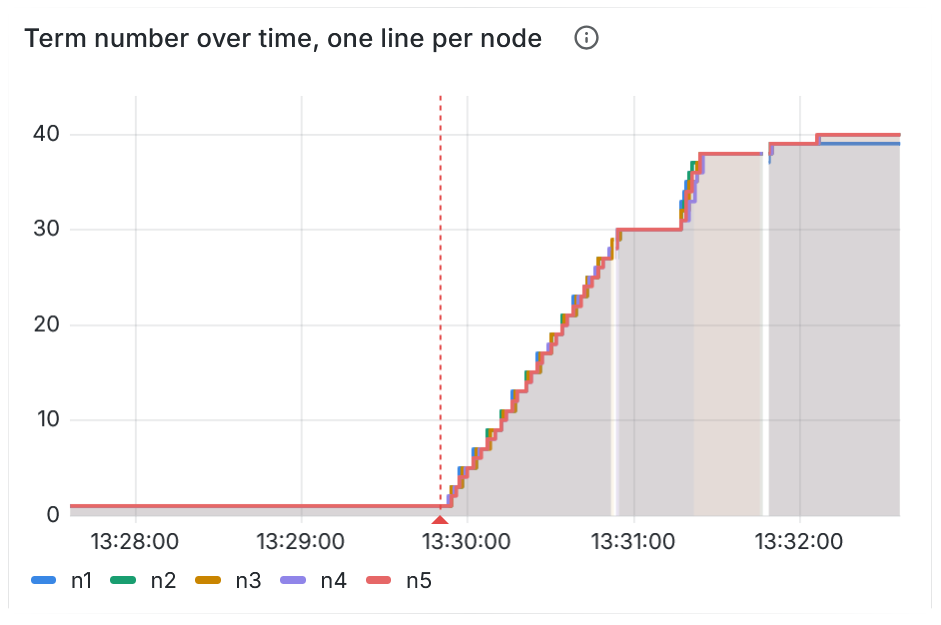
First question: does the term keep climbing the whole time the partition is unstable, or does the cluster eventually settle?
Term number over time, one line per node. Red marker is the fault injection.
Before the fault, everything sits flat at term 0. Healthy baseline: one election, then settle.
Right after the marker, the term starts climbing almost immediately.
From there it's a near-continuous staircase, roughly 0 to ~40. About 30 terms in ~70 seconds, so an election every 2–3 seconds.
All five lines move together. It isn't just the cut-off nodes (N4/N5) racing ahead. The whole cluster's term gets dragged up.
2. Commit index over time
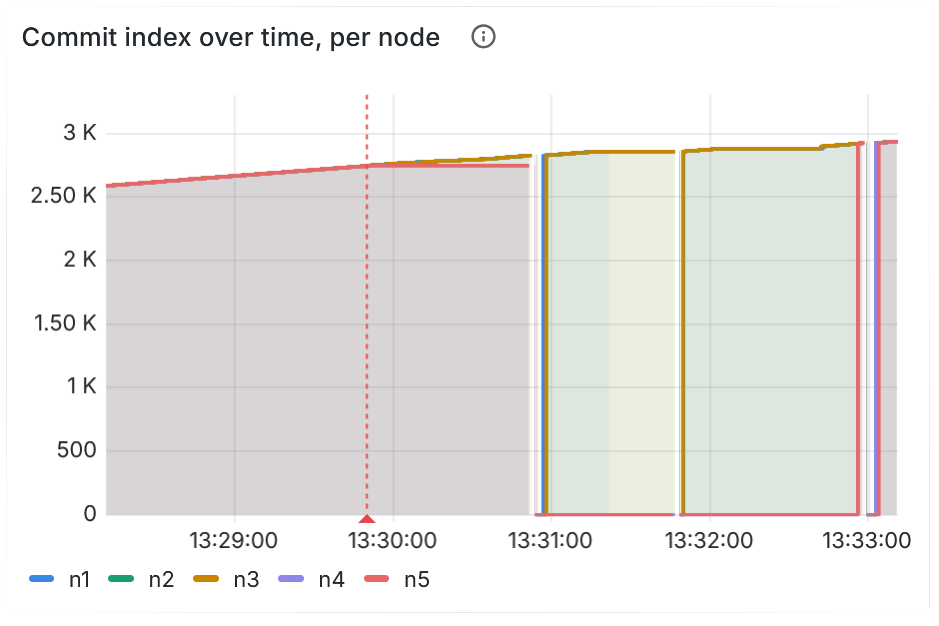
Same run, now looking at how much actually got committed while elections were firing.
Commit index over time, per node. Same window as the term graph above.
During the heaviest churn, commit index barely moved. A slow creep from ~2.55K to ~2.7K over about 90 seconds, a fraction of normal throughput.
It didn't flatline completely either. Writes still trickled through between elections.
Total outage would have been a boring result. What showed up instead is an availability tax that scales with churn rate: more elections per minute, less commit progress in that window.
[2] Stalled writes
When a leader can't reach a quorum, do the writes it can't commit fail loudly, or get silently swallowed?
1. Write outcome rate
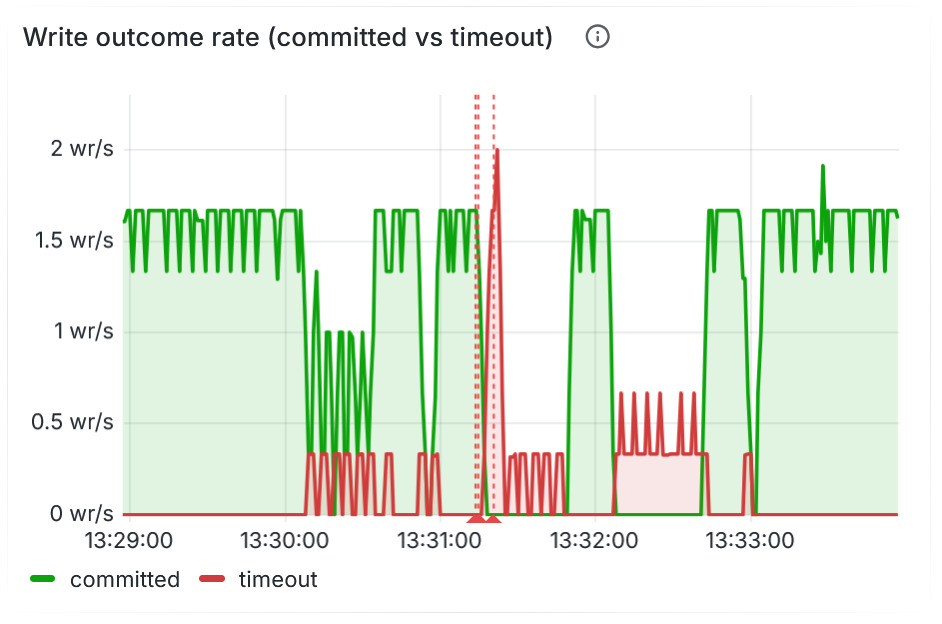
Every submission ends as committed or timeout. Plotting both rates side by side shows exactly what the client experiences the moment the leader loses its majority.
Write outcome rate, committed (green) vs timeout (red). Red marker is the fault injection.
Baseline sits around 1.5–1.65 writes/sec committed, with the green line notching down and back up as leadership hands off. Zero timeouts.
At the marker, the two lines swap. Committed collapses to 0 and timeout spikes to its peak of ~2 writes/sec, the client hammering a leader that logs the write but can't get it past 2-of-5.
Then a low timeout plateau, roughly 0.3 writes/sec, holds while committed stays pinned at 0. Nothing is getting through, and the client knows it.
Once the majority side elects a new leader, green jumps straight back to ~1.65 and the timeouts vanish. A second shorter timeout patch around 13:32 lines up with the crash-and-re-elect window before it settles for good.
The point of this one isn't that writes failed, it's how they failed. Every write the leader couldn't commit surfaced as a timeout in the client ledger, never as a false committed. When N1's uncommitted entry got overwritten on rejoin, no acknowledged write went with it. That's the difference between a stall and silent data loss.
[3] Log divergence
A fully isolated leader keeps appending. How far does its log drift from the real one, and does it ever come back?
1. Divergence magnitude
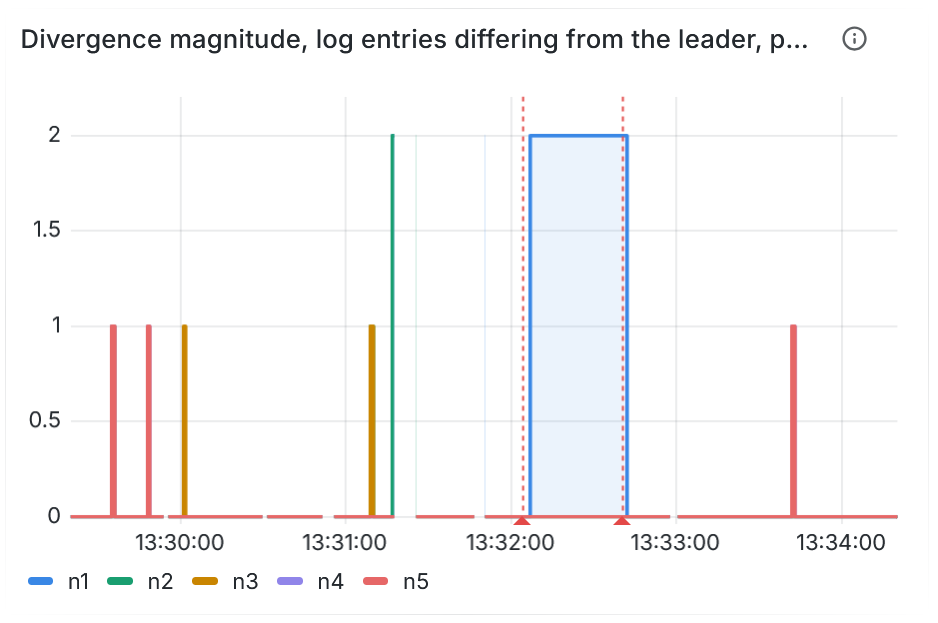
For each follower, count how many log entries differ from the current leader's log at the same positions. Zero means everyone agrees; anything above zero is a fork waiting to be reconciled.
Log entries differing from the leader, one line per node. Shaded band is the isolation window.
Most of the run sits flat at 0. The brief single-entry blips from N2, N3, and N5 before the partition are ordinary handoff lag, one entry out of step for a tick, then reconciled.
Inside the isolation window (shaded), N1 holds a steady divergence of 2 entries, the writes it appended alone while cut off from everyone. Those entries were never going to commit.
The divergence is bounded. It doesn't run away, it caps at exactly the number of entries the isolated leader wrote by itself.
The instant the partition heals, N1 drops straight from 2 back to 0. N3's AppendEntries backtracks past the mismatch and forces N1 to discard its divergent tail and copy the committed log instead.
This is the log-matching property doing exactly what we expect. A leader that lost its quorum forked its log, but the fork was bounded and self-correcting: erased the moment a real leader could talk to it again, with no operator intervention.
Conclusion
Three faults, three different failure modes. The interesting question was never does it fail, everything fails, but how. The term staircase, the writes that stalled into timeouts, the leader that forked its log and then had it repaired, all of it is behavior we expect.
The dangerous system is the one that looks healthy while quietly dropping an acknowledged write, and that's exactly the failure the client ledger existed to catch and never did.
Newsletter
Get new notes on distributed systems when they go out.